
Bansuri
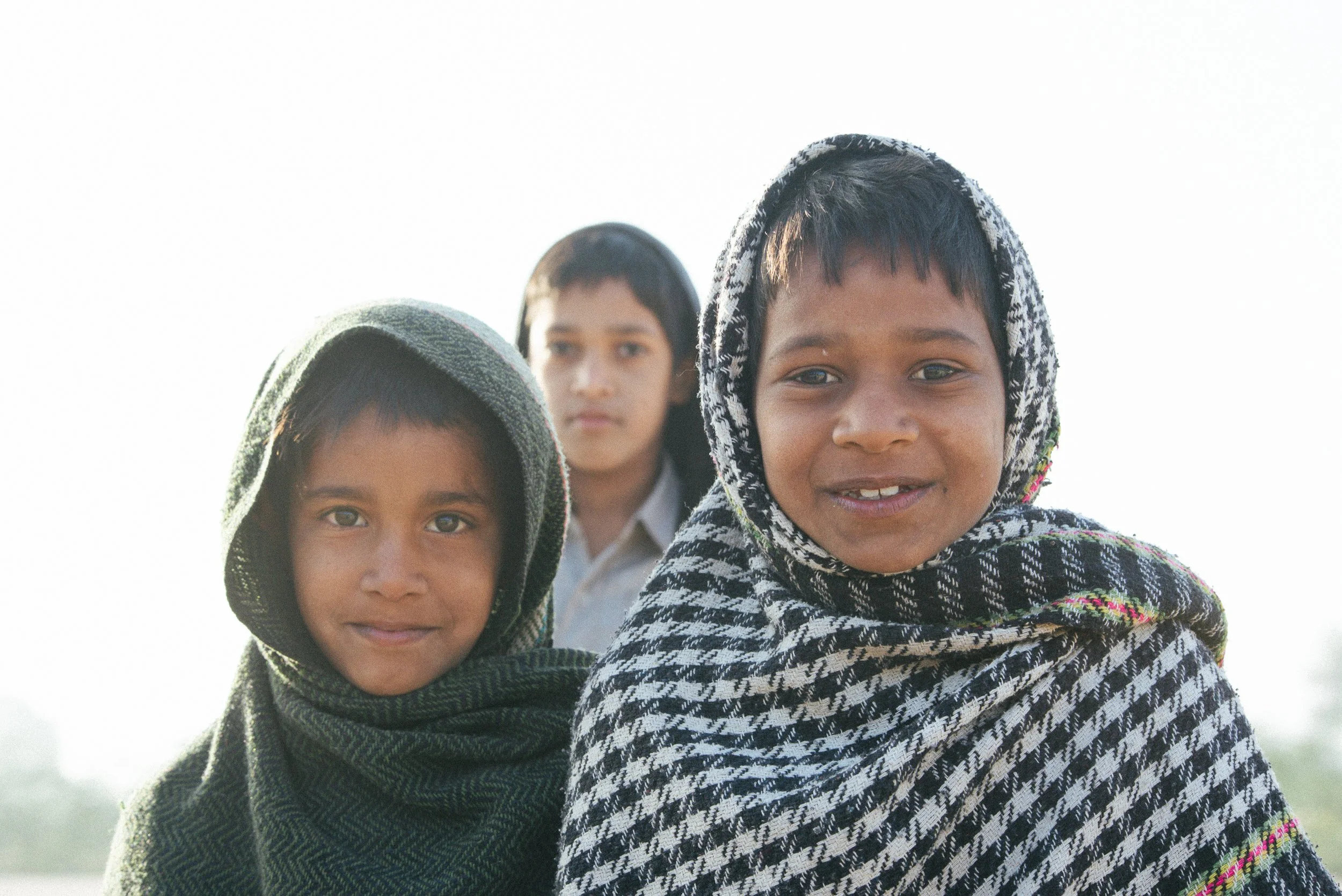
This story is a work of fiction inspired by a single photograph taken in a small village in northern Gujarat, India. The three boys in the image are real. Their names, their stories, and the bansuri are imagined — though perhaps not entirely.
— Mark Eden
In the pre-dawn silence, three young boys step from their homes on the outskirts of a village in northern Gujarat. The houses, low slung and pale under their curved terracotta roofs, glow softly in the blue light and the air is still and cool, not yet warmed by the sun. In the mid-distance koels and laughing doves begin to call as they wake.
The morning’s first chores await. As the eldest or only sons, all three are tasked with grazing the family goats at dawn before the heat arrives.
A heavy timber door closes carefully against the dark. Then another. Then a third. Three boys step down from their otlas and pad, sleep-drugged and wrapped in blankets, across their aangans towards the earthen-floored lean-tos where the family goats are kept. House sparrows scatter as they near and dogs, always light sleepers, raise their heads.
Each boy lifts aside the rough brushwood barrier of the goat shed and allows the Marwari goats to shuffle from their enclosure. Gently they prod the animals out of the compound and set out towards the grazing fields.
Along baked-hard and cracking dirt laneways they pass clusters of ber trees, their fruiting season now long passed, and thorny babools, which the goats begin to investigate for any low-hanging branches.
The three converge on the village talavdi where each boy stops to water his goats. The pond is almost dry this time of year. Drier than last year. The boys nod a silent acknowledgement to each other as the animals dip their heads to drink, ears drooping toward the water. They will guide the goats to their family’s fields to eat the weeds and stubble and fertilise the ground ahead of the kharif planting. This is a season of slow days spent waiting for the monsoons. With luck there will be enough rain this year to ensure a good crop.
Dilip
Dilip sits on the low earthen ridge that marks the boundary of his field, the same one he sits on every morning, and watches the two goats work the field edge for whatever the season has left. Dry stubble, sparse tussocks, the odd weed between the cracked earth. To the east the sky is paling but the sun has not yet come. Already the air is warm and Dilip can feel the west winds start to pick up. Could be a dust storm coming, he thinks to himself. They are common this time of year.
Thirteen years old, shy and small for his age, Dilip has always enjoyed the early morning where he can be alone with his thoughts and his imagination, creating worlds and stories with himself as the lead character. Adventures he will have, things he will become. Today he is a famous musician. Travelling across Gujarat and playing to adoring fans. He is thinking of the applause and calls of “More, more” when a large bird wanders out of the scrub at the field’s edge. Its feathers electric blue in the pre-dawn. It addresses him calmly and he returns the gaze and dips his chin, a long-held practice whenever he encounters one. They make him think of Krishna, who he has been studying in secret: a small worn book found at the market in town and hidden beneath his sleeping mat where no one will find it. His father is not a man without feeling. Dilip has seen him pause at a sunset or watch a flight of birds cross the field with something unreadable in his face. But he is a man who has made his decisions, and one of them is that beauty is a thing you notice and move past. A boy dreaming of gods and music would confirm every worry his Bapu had about him. So he keeps it to himself, this small burning thing.
“The Peacocks,” he says to himself. “That’s what my group will be called.”
As quickly as the peacock appeared it is gone, and Dilip’s gaze drifts back to his animals. Something seems off, something’s missing. He realises he is staring at one goat instead of two. He panics. These goats are his family’s most valuable possessions. Losing one would be unforgivable. His mind begins to race: a stray dog took it. It chased a mongoose and is now far away and lost. “No, this can’t happen”. He scans the horizon, furious with himself. Then, relief washes over him. In the far corner, in the shadow of the single khejri tree at the field’s edge he sees the goat. Hurrying over to steer it back, Dilip sees it is chewing on a large stick. Strange, he thinks. Goats don’t usually chew bare sticks. Maybe it has a bad tooth. It seems to be bleeding onto the stick.
Only when he is closer does he notice the stick is unusually straight and the red is not blood but paint. A careful stripe of it near one end, geru-red, dry and slightly powdery where the soil had got to it, still warm in colour where it hadn’t. Wrenching it from the goat he brushes away the dirt and sees this is not a stick at all, but an instrument, a flute of some kind. More bands of colour emerge, the red contrasted with a lighter, dusky pink. He looks back to where the peacock had stood moments ago. The goat has forgotten the incident and gone back to grazing.
Dilip turns the instrument over in his hands, remembering an evening long ago when an uncle had come to visit. After dinner his uncle brought out a flute and played. Dilip had been very young. He remembers almost nothing of the melody, only the feeling it produced, like a door opening somewhere inside him. It had sounded like possibility.
“A beautiful thing, to play music,” Bapu had said that night. “Such a shame a man can’t make a life from it.”
Dilip begins to raise the instrument to his lips, inhaling slowly, then stops midway. Silently he lowers it again and wraps it inside his blanket and calls the goats to follow him home. He has many more chores to complete this morning.
While walking home Dilip’s mind begins to wander again. Reimagining the musician story, this time with the instrument. He can hear the sound, floating and distant. After some time he sees the figure of Nathu on the road, guiding his own three goats.
“Nathu look,” Dilip says, catching up to him. Although younger by a couple of years, Nathu already stands a head higher than Dilip, and has strong, square shoulders compared to Dilip’s narrow frame. For some reason he can’t explain, Dilip has always wanted to impress him. He produces the flute from inside his clothing and holds it up. “I found this in the field”.
Nathu
Nathu stares at the flute for a moment. “What was it doing there?” he asks.
“I don’t know,” says Dilip. He’d been so preoccupied with his fantasy world it hadn’t occurred to him to wonder.
“Maybe someone lost it at the market,” suggests Nathu. He offers two or three more explanations, each less convincing than the last, his eyes not quite leaving the flute in Dilip’s hand. He is talking to fill space, something he does when unsettled.
“Do you think it’s worth anything?”
Nathu considers his answer but before he can respond, Dilip holds out the instrument to him. Taking it in his own hands, he turns it over slowly, examining the bands of pink and red. “There’s a crack,” he says, pointing to a hairline fissure at one end. “Probably not”.
He is about to pass it back but when he looks up, Nathu sees that Dilip has started on his way home again.
He brushes some more of the dirt away and turns it over again, noticing its craftmanship for the first time. Perfectly carved bamboo with delicate thread binding. With the soil removed he can see it was once highly varnished, but this had worn away around the finger holes. The binding now dry and soil-stained, fraying at one end. Somehow this makes it seem more beautiful. This stops Nathu for a moment. Beautiful? He’s never considered objects as beautiful before. Things are just things, they’re either useful or they’re not. But someone had clearly treasured this flute.
Dilip is already too far away to hear the flute as Nathu blows across the opening. Not a note exactly, but a ghost of a sound. He lowers it quickly, checking no one has seen him. The tiny noise triggers a memory fragment and the world stands still as he tries to place it. He has never paid much attention to his mother’s humming before as she goes about her daily tasks, but he’s reminded of it unexpectedly. Not knowing now what to do with the flute, he tucks it away and hurries to catch Dilip.
At the gate of Nathu’s family compound, the two boys see Gopal also returning home with his own herd, his hair and clothes rumpled as always. Tall, thin and stooped, Gopal is the closest Nathu has to a neighbour, their homes being several hundred metres apart, with Dilip’s some way further along the same laneway, towards the ruins of the old village vavdi.
“Nathu, what’s wrong?” asks Gopal, noticing the look on his face.
“Um, nothing. I mean…” He isn’t sure how to explain what he’s feeling. He must look strange for Gopal to notice, he thinks. He usually never notices anything. Always in his own world, singing to himself under his breath. Dilip has seen the change of mood as well but says nothing.
In place of a response, he takes out the instrument and holds it for Gopal to see. Gopal’s eyes widen as if he’s seen a ghost. “Where did you get this?”
“From Dilip,” he says.
“It was in our back field,” adds Dilip. “One of the goats had it in its mouth. I got there just in time.” He points out the bite marks.
Gopal has gone quiet. He looks like he’s in some kind of trance, staring at the flute. “Bansuri,” he finally breathes.
“What?”
“Bansuri,” he repeats, louder this time. “That’s what it’s called. They’re really old. They were played in ancient times.” He describes how the bansuri appears in paintings hundreds of years old, from a time when their country went by many names — Bhārata, Hindustan, Aryavarta — its borders always shifting, its music always continuing. The other two can only nod, astounded. They have no idea where Gopal has learned all this.
Nathu raises the flute again, hesitates, thinking of its sound and Maa once more, then hands it to Gopal. He sees something move across Gopal’s face.
Gopal
Gopal wants to thank him but the words won’t come. He smiles instead, taking the bansuri with both hands, afraid to damage it. There has always been a melody running through him. Through chores, through school, through the long hot afternoons, arriving uninvited, sometimes quieter than others but never quite leaving. He has told no one. Such dreams are not for the likes of him.
He looks at Nathu again. A silent question. Are you sure?
Nathu shrugs. “It’s cracked,” he says. Gopal has a sense he’s trying to justify to himself, but he accepts the bansuri, knowing his friend has decided. I couldn’t have played it anyway, Nathu thinks. He knows this without quite knowing how.
Gopal has never held such a thing before. Never touched an instrument of any kind. His long elegant fingers trace the crack as he wonders idly about its history. How old is it? Who did it belong to? How far has it travelled? He’ll never know its past. But he knows, somehow, that he will be part of its future.
Gopal wipes the mouthpiece on his cotton trousers, intending to clean the remaining soil but merely spreading it. His hands are steady, but his heartbeat is loud in his ears. He tries to calm his breathing. After a moment he raises the instrument to his lips and, closing his eyes, blows gently. The sound is thin and reedy, out of tune and trembling, but somehow beautiful.
The other two boys know better than to say anything. They just stand and listen. The animals seem to know too; goats lift their heads but make no sound, their long ears swinging. Birds that were moments ago chattering have gone silent.
Gopal smiles. It’s not music, but it’s something. A beginning. “I’ll take good care of it,” he assures the others.
Along the road, the three see a flash of colour. Vivid blue disappearing into the shrubbery. Gone before they can be sure.
The boys know they cannot linger. Always more work to be done. So they each turn and head for home.
Gopal enters his compound carrying the bansuri in both hands, more carefully than he has ever carried anything. At the threshold he pauses as his younger sister looks up from where she sits sorting lentils and stares at the object in his hands. Her eyes move to his face. Something stills her for a moment. Then she looks back down and continues her work. Gopal watches her for a moment, then quietly tucks the bansuri inside his shirt and continues across the aangan. Inside him the melody is clearer now. He is already planning for the next moment he can be alone.
Nathu begins to hear a melody as he nears his front entrance, and he realises it is Maa humming again as she sweeps their aangan, bending low with the short broom, her saree reduced to a silhouette in the middle of a cloud of dust. This time though, he pays attention. It is a lilting tune, slow, honeyed and plaintive. “What song is that?” he asks. Taken aback, she gathers herself before answering. He has never asked such a question before. “It’s called Vaishnava Jana To. It’s a very old song. Your Dada used to play it on a bansuri.” Nathu says nothing, just nods and continues herding the goats into their enclosure. He never knew his grandfather, never knew there was a musician in his family. Somehow the news isn’t a surprise though. He thinks of the bansuri he held just a short while ago, wondering how alike Dada’s was. His mother smiles to herself. Maybe he will become interested one day, she thinks.
Dilip is the last to reach home. On the way his mind has floated back to his fantasy world. This time though, he is a wealthy businessman, sitting in the VIP seats at the same concert. On stage is a classical group, the lead musician a flutist with a bansuri. He looks a lot like Gopal with his rumpled hair, though older now, and straight-backed in a fine silk kurta. Dilip hears the music curling and climbing. He doesn’t notice his father leaving for the fields as he enters his front gate, dressed in dhoti and phento for a long day in the sun. His father glances back, used to Dilip’s ways. “What is he dreaming about this time?” he says to himself as he starts along the same dirt laneway Dilip travelled earlier.
The day is hot now, the sun bleaches the landscape and dust dances on the warm wind that has come with daybreak. The village is noisier too. Farmers till their fields and women work at washing or cutting vegetables. The calls of the koels have increased both in volume and frequency and dogs bark at irregular intervals. Someone sings as they work.
At the edge of a farm field, a single peacock watches. Its half-fanned tail catching the light, warming in the sun. It tilts its head slowly, turns, then, in an instant, it is gone.